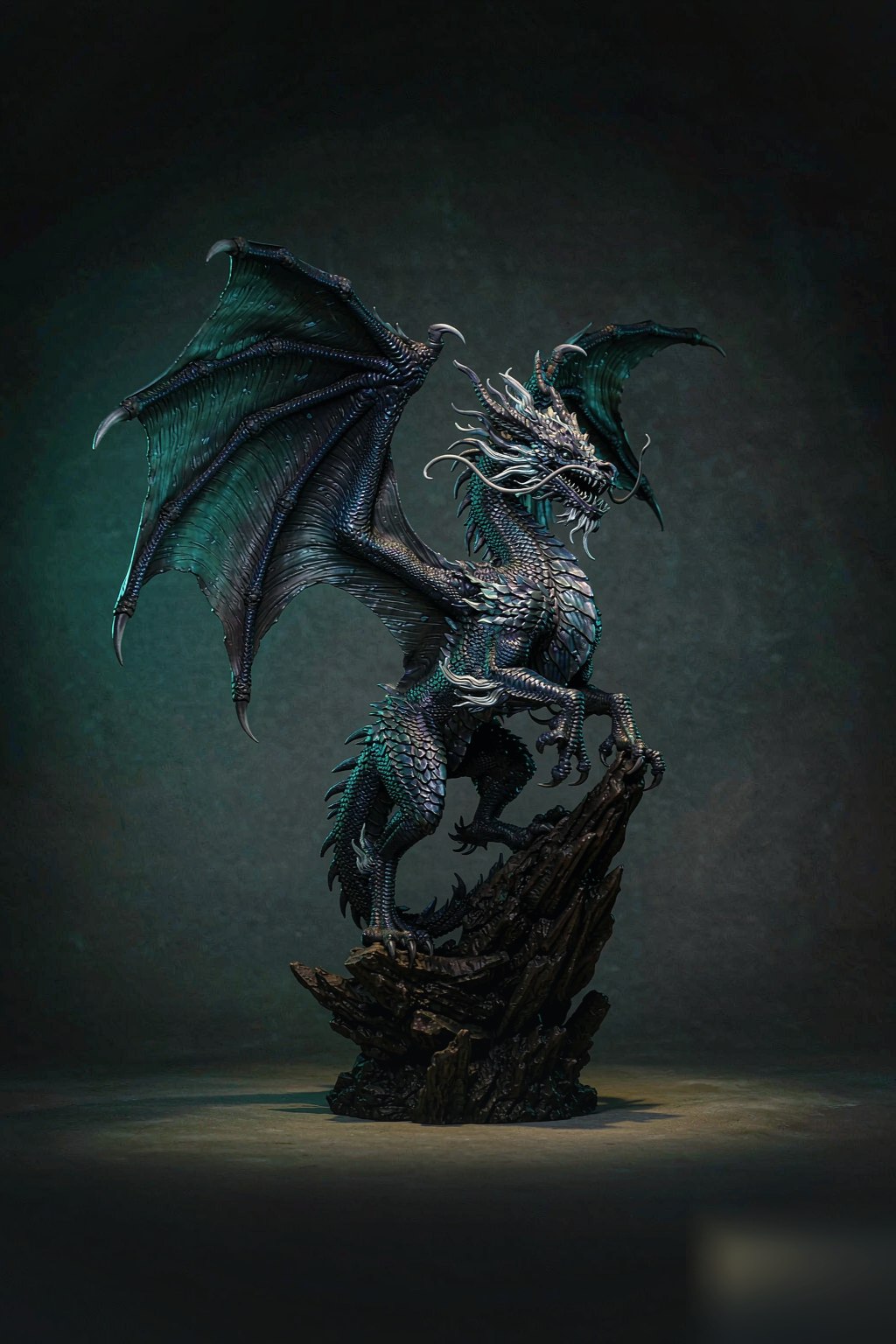
Most first-time buyers ask the wrong question. They ask how long it takes. The question that actually determines cost and risk is where the design stops being changeable — because that is the point where every earlier decision gets locked in.
Here is the sequence as a buyer experiences it, with the decision that each stage closes.
1. What you send
A project starts with a reference pack. In practice that means some combination of:
- concept art or a turnaround sheet, showing the character or object from more than one angle
- a sense of scale and intended dimensions, including the base
- material intent, if you have one
- edition size, or at least an order of magnitude
- packaging intent — display box, window box, or something else
- for licensed work, the documentation of your authority to use the property
If you only have a single front-view illustration, that is workable — but it is the single biggest driver of review rounds later, because every unseen angle becomes an interpretation someone has to approve.
2. Feasibility review
Before any sculpting, the design is read for what will not survive the transition from drawing to physical object. This is where we push back, and it is the most valuable conversation in the project.
Typical points of resistance:
- Undercuts — shapes a drawing allows and a mould does not
- Unsupported thin elements — hair strands, weapon tips, capes, antennae
- Cantilevers — anything whose weight is doing something gravity disagrees with
- Translucent and gradient paint effects — beautiful in a render, and highly dependent on edition size
- Visible seams — where parts must separate, and whether the split line can be hidden
- Base stability — the centre of mass is a design property, not an afterthought
None of these are refusals. They are questions with answers, and it is far cheaper to answer them now.
3. Sculpt and approval
The sculpt is the design made physical at full size, and it is reviewed in rounds. What matters for you is not the software or the technique — it is that you understand what approving a sculpt means.
Approving a sculpt means the form is settled. After that point, changes are not edits. They are rework, with new tooling behind them.
This is the stage where we ask buyers to be slow. It is the last cheap moment.
4. Tooling
Moulds and tooling are derived from the approved sculpt. There is a real point in this stage after which a form change means rebuilding the tool rather than adjusting it — and the cost of a change does not rise gradually across the project. It steps up.
Practically: everything you want to change about shape should be raised before tooling, and everything you want to change about colour should be raised before the paint stage.
5. Paint and colour approval
The paint stage turns the approved form into the approved appearance. Two honest constraints apply here:
- A rendered concept and a producible finish are not the same target. Metallic sheens, soft gradients and glow effects behave differently in volume than they do on a screen, and the difference grows as edition size grows.
- A finish that is achievable on one sample is not automatically repeatable across an edition. What gets approved is a standard that production can be held to, not a single beautiful piece.
6. The pre-production sample
Before production, a reference sample is approved. Once approved, it becomes the standard that everything else is measured against — for form, for finish, and for packaging.
This is the last gate. After it, the question changes from "is this right?" to "does this match?"
7. Production, numbering and packing
Production runs against the approved standard, with inspection at defined points rather than one look at the end. Individually numbered editions carry a traceable record: an edition number maps back to a production batch and its inspection records. That mapping is what makes a numbering claim meaningful rather than decorative.
We produce in Huicheng District, Huizhou, Guangdong, where the collectible line occupies roughly 20,000 m² — about one third of the group's total 62,000 m² across the Huicheng and Huiyang sites.
What actually causes rework
In order of how often we see them:
- A late change to form after tooling, for a reason that was visible in the reference pack from day one
- An unseen angle that was never drawn and therefore never approved
- A colour target taken from a render, with no discussion of how it behaves in production
- Play value added late — an articulated part or swappable accessory introduced as a feature, after the form was frozen, which changes both engineering and compliance
- A buyer who approves a sample informally — a message that says "looks great" instead of a signed approval against a written standard
Only the fourth is genuinely about manufacturing. The rest are process discipline, and they are the buyer's to control as much as ours.
What to prepare before the first conversation
- the most complete visual reference you have, including any back views
- intended scale, or a product it needs to sit beside
- edition size, even approximate
- the character or object's real-world context — what it holds, stands on, or hangs from
- any hard constraints from your side: packaging dimensions, retail display, licensing terms
You do not need a finished specification. You need the things whose absence would only be discovered later.
What we do not publish, and why: the specific process engineering behind these stages is not described here, and process photography on this site is deliberately obscured. That is a condition of working on unreleased properties, and it applies to every client equally.