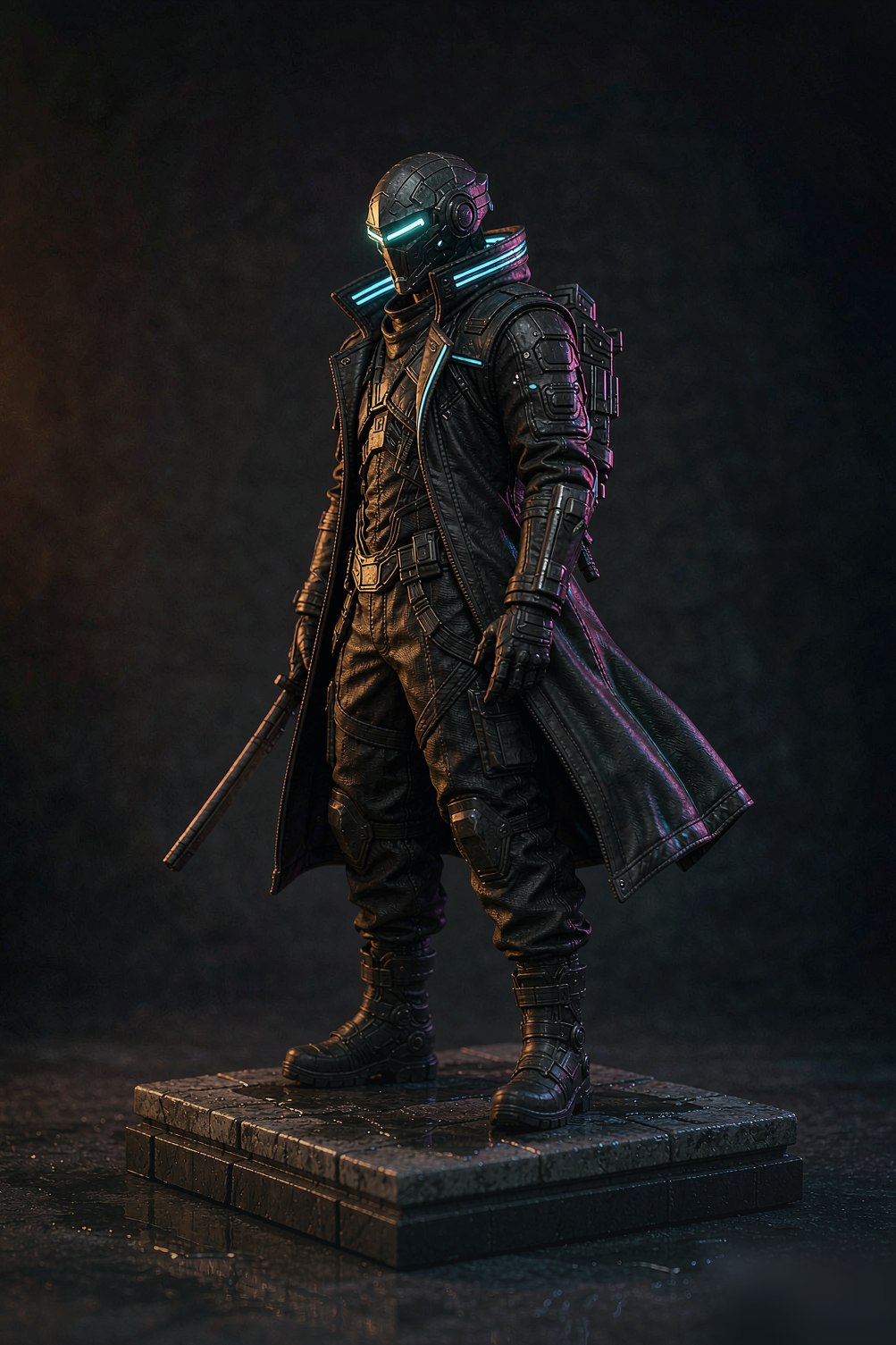
Most licensing problems in collectible manufacturing do not come from someone deciding to infringe. They come from three genuinely different rights being treated as one, at the point where a physical object becomes publicly visible.
Getting this right is not paperwork. It is the difference between a production partner you can put on a launch and one you have to manage.
Three rights, not one
| Right | Who normally holds it | What it covers |
|---|---|---|
| Manufacturing authority | Held by the licensee, passed to the factory as an instruction to produce | Making the physical object |
| Display permission | May be granted by the licensee to the factory | Showing the finished work — portfolio, capability material, samples |
| Trademark and character-name use in marketing | Held by the property owner | Using names, logos or marks in advertising, product naming, URLs, file naming, metadata |
The third one is where the trouble is. An instruction to manufacture is not a licence to market, and a factory that treats the two as equivalent creates exposure for its client — not for itself alone.
Where a boundary actually gets crossed
It is rarely a photograph of a product shelf. It is usually much quieter:
- a filename — `client-name-character-name.jpg`, discovered later by an image search
- alt text on a portfolio image, which is indexed and read by assistive technology
- a URL slug created for a capability page
- image metadata carried over from a camera or asset library
- CDN and server logs recording a file path that contains the mark
- rights-holder monitoring, which searches images rather than websites and finds the filename before it finds the page
None of these require anyone to make a marketing decision. They are created by default behaviour, which is exactly why a policy has to exist rather than a good intention.
Our position
We show finished work only with the client's permission, and we name neither the client nor the property — not in the visible caption, not in the filename, not in the alt text, and not in the surrounding copy.
This creates a real cost, and it is worth stating plainly: our portfolio is less searchable than it could be, and a visitor cannot look up which properties a piece came from. We accept that. A factory's marketing convenience is not a reason to spend a client's trademark right.
It also means something for you as a buyer. If you were expecting a manufacturing partner to promote your launch for you, that is a media arrangement, not a manufacturing one. It should be agreed as a separate thing, in writing, if you want it.
The boundaries that trip people up
Approved art is not approved marketing use. Concept approval covers the object. It says nothing about where the object may then appear.
Rights are territorial and time-limited. A permission to display may not extend to every market your piece sells in, and the term matters for archive material. A portfolio image published during a licence may need to come down when the licence ends.
Factory-as-licensee is a different relationship from factory-as-supplier. A manufacturer holding its own licence for its own product line is operating under a different set of rights than one producing against someone else's. The two should never be conflated in capability material.
Samples travel. A pre-production sample sent to an internal review and a sample displayed at a trade show are subject to different permissions, and the second one is easy to arrange accidentally.
Tooling outlives the licence. Who owns the mould, and whether it must be returned or destroyed at the end of the term, is a term that has to be agreed before tooling is cut. Retro-fitting it afterwards means either an uncomfortable negotiation or a liability sitting in a factory indefinitely.
Permission does not travel down the chain. A display permission granted to a manufacturer grants nothing to that manufacturer's own suppliers — component makers, finishing contractors, contract packers, or the agents who sell on its behalf. Each of those is a separate party who sees the work. The same applies to territory: a permission granted for one market does not follow a piece that ships to another. This is often treated as a legal question, but the moment sub-contracted work is involved it becomes a manufacturing question, because it is decided by who is actually in the building.
What a buyer should hold, and ask for
Documentation worth having in hand before production:
- your chain of authority — the licence or authorisation that lets you have the product manufactured at all, including by a third party
- territory and term, and whether sub-manufacturing is permitted
- a written display permission — or an explicit instruction not to display, which is equally valid and much clearer than ambiguity
- a tooling clause — ownership, storage, return or destruction at end of term
- a named approval contact, so "approved" means one specific person
- an agreed handling rule for pre-launch work, since the sensitive window is the gap between the design existing physically and it becoming public
And, when selecting a partner, ask directly:
- Do you photograph client work, and under what permission?
- Do you name clients or properties anywhere in public material, including file names and metadata?
- Where does tooling live when a licence ends?
- Who inside your organisation can see unreleased work, and when does that access end?
- Who outside your organisation sees it — component suppliers, finishing contractors, packers, sales agents — and are they under the same terms you are?
The second question is the one that separates a policy from a habit. If a manufacturer can answer it without checking, the policy exists. The fifth is the one that separates a policy from a perimeter: the first four can all be answered correctly by a factory whose suppliers are doing whatever they like.
Why we err toward under-displaying
There is an argument that a factory should show everything it has made, and it is not a dishonest argument — capability is genuinely best demonstrated by work. But the cost of that argument is paid by the client, in trademark exposure they did not authorise and may not even know about.
Our choice is the conservative one, and it is stated in advance so nobody is surprised: we show the work, we do not name it, and we do not use it to describe ourselves.
This article describes how we handle permissions and public material. It is not legal advice. Licensing terms are specific to each property, and the terms of your own agreement govern.