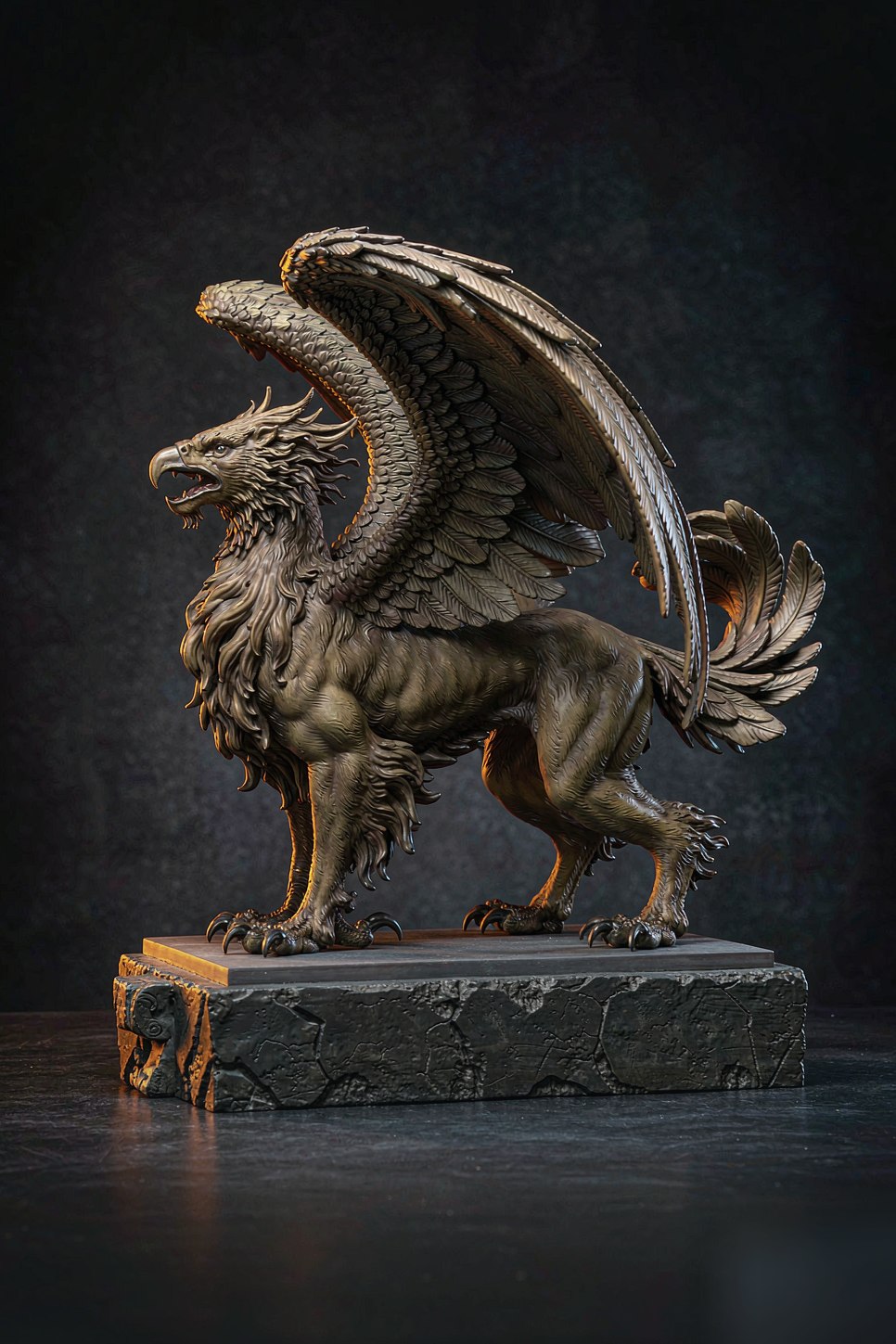
Two buyers can send the same illustration to two manufacturers and receive quotes that differ by a large multiple, for reasons that have nothing to do with either factory being more or less expensive. What differs is usually what each quote includes, and what each manufacturer assumes the project is.
Understanding the structure is what makes a quote comparable. This article is about the structure. It does not contain rates, and it will not — the last section explains why.
Why a quote needs more than a picture
A photograph or illustration fixes appearance. Manufacturing cost is driven by things appearance does not state: how many separate pieces the object must be built from, how each one leaves its tool, how many paint operations the finish requires, how the piece is inspected and how it is packed.
A manufacturer quoting from a picture alone is estimating those in their head and hoping. Sometimes that works. When it does not, the difference appears at the tooling stage, after the budget has been set.
The two halves of the number
Every project cost splits into a one-time side and a per-unit side. They behave completely differently, and conflating them is the root of most confusion.
One-time costs are incurred once per design, regardless of edition size:
- design development and sculpt, including the approval rounds
- tooling — and the number of tools tracks the number of separate parts
- paint development and colour matching, including the paint reference
- the pre-production sample and its approval
- packaging development and the structural prototype
Per-unit costs are incurred for every piece produced:
- material, by mass and by material mix
- labour for hand-applied finishing — normally the largest per-unit item on a collectible
- assembly, fitting and numbering
- inspection, at whatever intensity the acceptance standard requires
- packaging materials and packing labour
The amortisation effect, and what it really means
One-time costs are fixed. Divide them by the edition size and you get the tooling share of each unit.
This produces the single most consequential fact in small-batch planning: a change in edition size moves the per-unit number differently than buyers expect. Doubling an edition does not halve the price of each piece, because the per-unit side does not shrink. It reduces only the amortised share of the fixed side — and as the edition grows, that share becomes a smaller and smaller part of the total.
The practical implication is about where to look for savings. On a small edition, the compounding happens on the fixed side: fewer parts, fewer tools, fewer paint operations, fewer approval rounds. On a large edition, the leverage is on the per-unit side: finishing labour, inspection and packing.
Applying the wrong lever is how projects end up over-engineered for their edition size.
Tool life is a cost driver nobody asks about
The amortisation model above has a silent assumption in it: that the tool can produce however many units the edition requires. It cannot. Every tool has a service life, and that life is finite.
Two consequences follow, and both show up in quotes that otherwise look comparable:
- It caps how far a fixed cost can be spread. Past the tool's useful life, "more units" stops getting cheaper per unit, because the tool is replaced rather than reused. A quote built on an edition size beyond that point is carrying a second tooling cycle inside the unit price — sometimes without either side having named it.
- It changes what inspection is for. As a tool wears, dimensional drift and surface degradation increase, so the last units off it are a different risk profile from the first. A standard that checks only first-off samples covers the start of the run and leaves the end of it unexamined.
The commercial counterpart is worth stating too: if tooling still exists and is still serviceable, a second edition of the same form starts from a much lower fixed base than the first. That is why tooling ownership, storage and retention are commercial terms as much as they are legal ones — a clause that requires a tool to be destroyed at the end of a licence has a price attached to it.
What moves the fixed side
| Driver | Why it moves cost |
|---|---|
| Number of separate parts | Each part needs its own tool. Part count is the strongest single driver of tooling cost |
| Sculpt complexity and undercut count | Undercuts require slides, splits or separate pieces to release from the tool |
| Approval rounds | Every sculpt revision after a certain point is rework on an approved form |
| Paint development | Each distinct finish is developed and matched before it can be reproduced |
| Packaging structure | A custom insert is a design project, not a purchase |
What moves the per-unit side
| Driver | Why it moves cost |
|---|---|
| Number of paint operations | Each colour pass, mask and gradient is discrete manual work. This dominates finishing labour |
| Part count and assembly operations | More parts means more fitting, more joints, more checks |
| Inspection intensity | Set by the acceptance standard, and it scales with the batch rather than with the sculpt |
| Finish fragility | A finish that marks easily requires more handling care at every step |
| Material mix | Weight and material choice feed into both material cost and freight |
The five decisions that change the number most
In order of leverage:
- Edition size — because it sets how much of the fixed side each unit carries
- Part count and split lines — decided in the sculpt, paid for in the tooling
- Number of paint operations — usually the largest per-unit lever, and often the least examined
- Packaging structure — cheap before the form is frozen, expensive after
- When changes arrive — a form change before tooling is an edit; after tooling it is a rebuild
Why comparison shopping goes wrong
Per-unit price is not comparable across quotes unless the scope matches. Two quotes for "the same" collectible can differ because one includes:
- approval rounds and the other bills each one
- an acceptance standard and inspection, and the other does not
- packaging design, and the other treats it as a separate project
- tooling amortised across the edition, and the other treats tooling as a one-off line
- a defined freight term, and the other quotes ex-works
Three questions make quotes comparable:
- What is included in tooling? Part count assumption, and who pays for tool modifications after approval.
- How many approval rounds are in the number, and what happens to rounds beyond that?
- Is tooling amortised into the unit price, or quoted separately? Both are legitimate. Mixing them across quotes is not.
Add a fourth: what edition size was assumed? A quote built on 5,000 units and one built on 500 are not describing the same project.
Why we do not publish rates
Because a published rate stops being information and becomes an anchor. Once a number is on a website, the conversation shifts from "what does this project need" to "why is it not that number" — and the second conversation is conducted without reference to part count, paint operations or edition size.
It is also the honest position. Cost here is a function of at least five design decisions that are not made yet at the time someone reads a web page. A rate published today would be wrong for almost every project, and wrong in both directions.
What we will do instead: read your reference, state the assumptions we are making, and quote against those assumptions so you can see exactly which ones drive the result. If an assumption changes, the quote changes with a reason attached.
What to send so the number is real
- the most complete visual reference you have, and a scale
- edition size, or a range you are genuinely considering
- whether anything must be translucent, articulated or detachable
- how the piece is packed and displayed
- any hard constraints: retail shelf, freight mode, territory
- which of the five levers above you are willing to move
That last one is the most useful line in the list. Cost is not a single number that gets discovered — it is a set of trade-offs that get chosen.